Recently we completed a freeform puzzle, one without the edge pieces on which we usually rely. It took us much longer to finish it without clear straight edged boundaries.
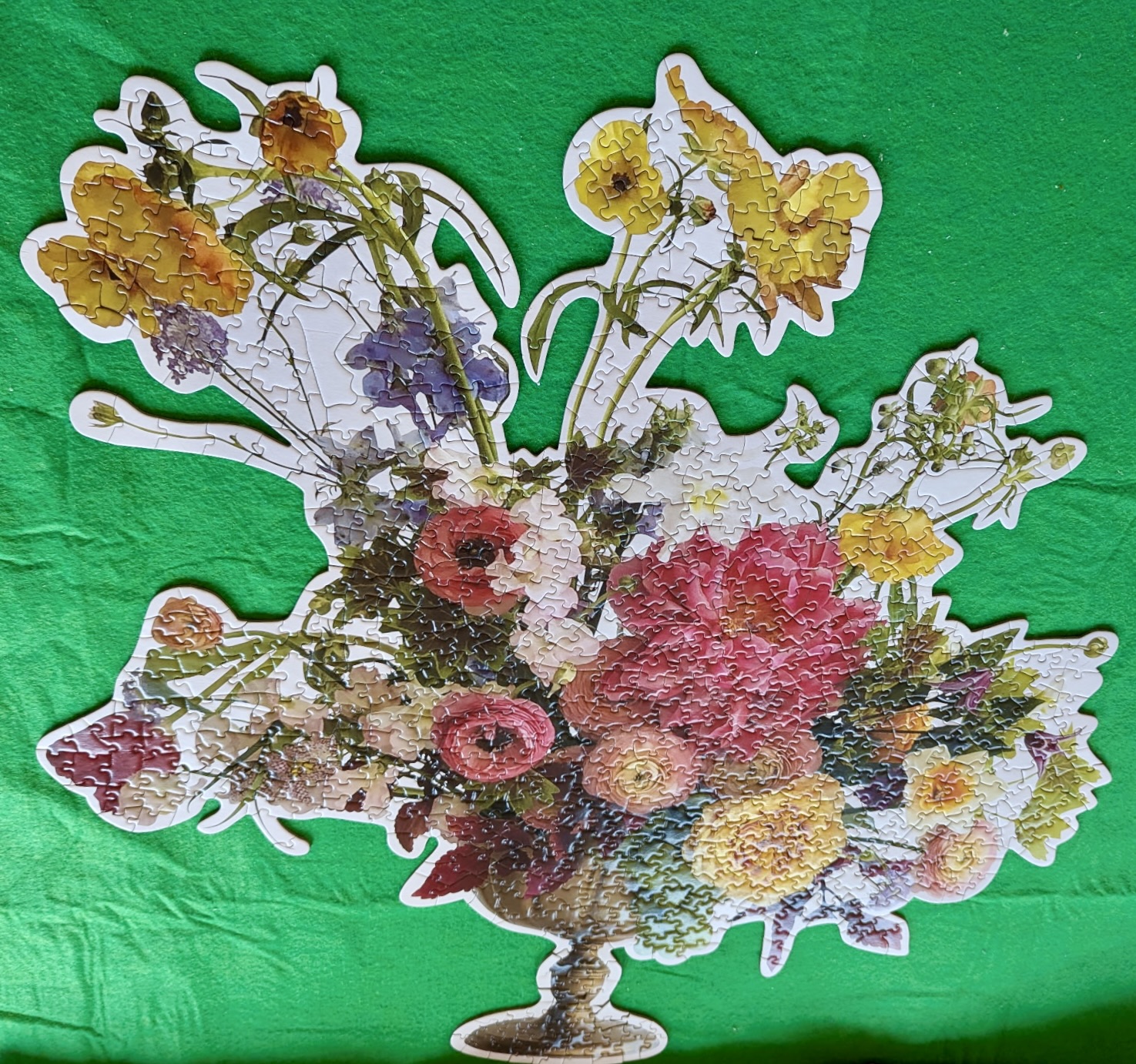
Doug approaches puzzles completely differently from how I do. He stays focused on the specific part of the puzzle he’s chosen to work on, while I work for a time on one color or object, and when I become frustrated, I either walk away or take up another color or object, so that I have multiple partially finished objects waiting to be fit into the whole.
But Christopher and I spent the most time working together on this puzzle. Chris has an ability to study a single piece in light of the whole and project where it will go, so he arranged my partially finished objects and worked with me to connect them and fill in the missing pieces.
Working a puzzle with no straight edged boundaries has me pondering boundaries in general. I think most of us are more comfortable knowing what to expect. Whether we’re going to a movie or a church service, we want to know about how long we can expect it to last. If we’re going to a dinner party we might ask who else will be there and what attire is deemed appropriate, a form of seeking out the boundaries. And big event organizers recruit volunteers to oversee our parking if we must park a vehicle in a lot with no clearly marked spaces. We want to know our boundaries, it makes us feel safer.
Then there are our own physical, emotional and behavioral boundaries which we have every right to maintain, not allowing others to manipulate us or to power past them in a way that jeopardizes our safety or integrity.
So, boundaries are good and healthy, and even our “freeform” puzzle has them. They are not as fixed and predictable as those of rectangular, square, or even round puzzles, but if they didn’t exist, we never could have completed the puzzle at all!
The boundary lines have fallen for me in pleasant places;
I have a goodly heritage.Psalm 16:6
 Inundated with Love